Remember “Perfect Sound Forever?” I do.
I was working on a sales floor when CD players first showed up. One of the guys grabbed a CD and threw it across the store like a Frisbee. He picked it up, dusted it off, put it back into the player and pressed Play.
Music.
So naturally, we escalated. Somebody discovered peanut butter made an excellent demonstration. Smear some on the disc, wipe it off, put it back in. Still played. We kept doing that for about a week. Eventually, Michael wasn’t quite as much of a Thriller anymore.
But something enormous really had happened. For most of our lives, music had been something we could hold.
The record carried more than the recording.
There was the jacket. Artwork. Photographs. Liner notes. Musicians. Producer. Engineer. Studio. And there was an order: Side One, Side Two. The artist decided what came after what.
Music discovery had something else that feels increasingly precious now: a human voice and a face.
Our parents had the late-night radio DJ, somebody behind a microphone who could play something we had never heard and tell us why it mattered. Then we had people like Ed at Tower Records. Ed knew old music, new music, obscure music and, after a while, he knew you.
You walked in looking for one record and Ed might put something completely different in your hand: “You guys have got to hear this.”
Algorithms can be astonishingly good. But there is a difference between “I think you’ll like this” and “I think you need to hear this.” One predicts our taste. The other can change it.
CD loudly changed everything.
CD digitized the recording, but it did not immediately kill the album. We still bought something. We brought it home. There was artwork, a booklet, credits, Track 1 and a final track.
Then several different ideas began colliding. The Music Genome Project, developed by the company that became Pandora, explored musical relationships as a path to discovery. iTunes made individual songs easy to purchase without buying the whole album. And eventually streaming changed the scale of access itself.
This is where Rick Beato’s discussion of abundance and the faucet metaphor is so useful. Spotify made the idea instantly understandable: turn on the faucet and the music keeps coming. Almost anything we want, almost anywhere, almost immediately.
That is an extraordinary achievement. It also changes our relationship with music. We once had to hear about it, find it, buy it, borrow it, trade it or carry it home.
This episode owes an unmistakable debt to Rick Beato’s commentary about streaming abundance, scarcity, album sequencing, artwork, credits and the context that surrounded physical music. The faucet image became an important way into this story.
The question is not whether streaming is good or bad. The useful question is: what did we gain, and what did we accidentally leave behind?
Access does not have to erase attachment.
Spotify belongs in this story because it helped make streaming a default listening behavior. Qobuz and TIDAL show another side of streaming, one aimed at listeners who care deeply about fidelity and curation. Purchased high-resolution files put digital ownership back into the mix.
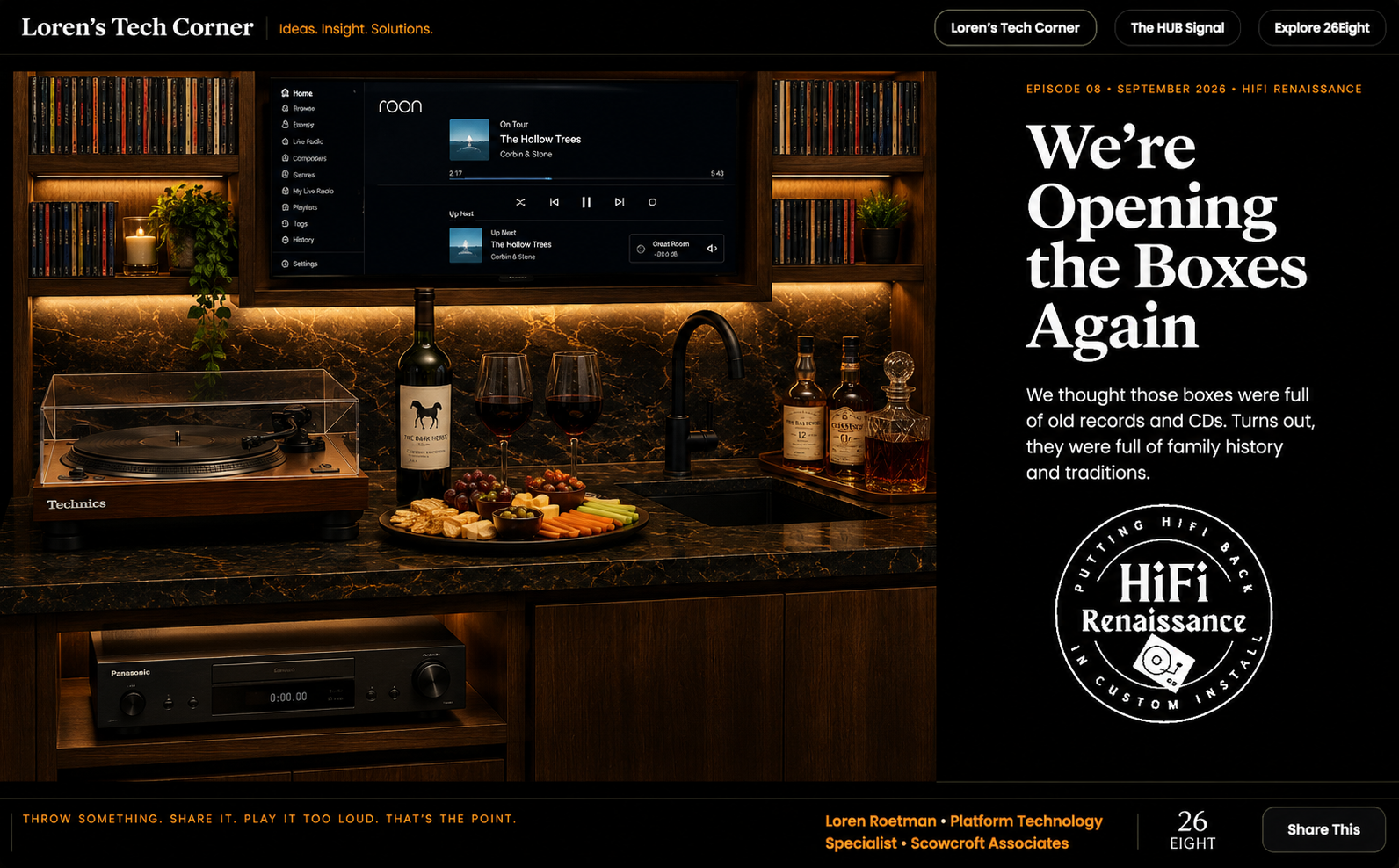
Then Roon starts pulling worlds together: the music we own locally, supported streaming services, Internet Radio, credits, artists, albums, composers, versions, relationships and discovery. When we want the machine to take us somewhere, it can. When we want the album, we can still choose the album.
Technology no longer has to make us choose one generation and throw the previous one away.
Those dusty CDs are becoming interesting again.
CDs that disappeared into cardboard boxes years ago are coming back out. And there is a wonderful generational symmetry in that, because my generation did the same thing with our parents’ records.
We found music we did not know existed. But we also found pieces of them. A worn jacket. A strange album we never would have searched for. A record that obviously mattered enough to survive three moves.
Now another generation can open a box of CDs and make the same discovery. Maybe Dad bought that CD because Ed at Tower put it in his hand. Maybe Mom owns that 45 because a DJ played it late one night and she had to know who it was.
Those collections contain breadcrumbs showing how music traveled from one human being to another.
The technology disappears. The music travels.
Now put the Technics turntable back at the bar. Add the Panasonic disc transport so the CDs can come downstairs again. Behind the scenes, the Silent Angel Roon transport brings the owned digital library, streaming services and Internet Radio into the same musical environment.
The Bluetooth wall plate has a different job. It brings the people in the room into the system.
Bluetooth brings the music to the room the way Mom used to bring her 45s to her friends’ house after school.
Someone says, “You guys have got to hear this.” The phone comes out. It connects to Bluetooth. That person’s discovery becomes everybody’s music throughout the house.
Mom carried a 45. We carry a phone. The technology changed. The human impulse did not.
Behind the scenes, Dante can be the house-wide audio network connecting these sources to the places where people actually listen. Nobody at the party needs to know what Dante is. They just need to know: put your music on.
Tradition, ritual and the physical album.
Physical digital ownership and rediscovery.
Owned files, streaming, Internet Radio, context and discovery.
The people in the room. “You guys have got to hear this.”
Two Rooms at a Time. A Whole Residence in HiFi.
The A-PRO2 turns a luxury residence into repeatable two-room HiFi suites with simple local control and a Roon-ready path. It is the practical residential architecture behind the idea: physical media, streaming and guest music can become sources on a system designed to travel beyond a single listening room.
Explore the A-PRO2 ConceptStop throwing the last generation away.
Records were old because CDs arrived. CDs were old because downloads arrived. Downloads became unnecessary because streaming arrived. Every time we moved forward, we threw a little something overboard.
Maybe we finally do not have to.
We can have the record. The CD. The high-resolution files we collected. Internet Radio. Spotify. Qobuz. TIDAL. Roon. Bluetooth. The algorithm. The human curator. And, most importantly, each other.
The point was never analog versus digital. The point was never the format.
We wanted to discover music. Own some of it. Know who made it. Bring it home. Share it. Play it too loud. And every once in a while walk into a room carrying something nobody else had heard yet and say:
We’re opening the boxes again. Not because we are going backward. Because there is too much good stuff in there to leave behind.